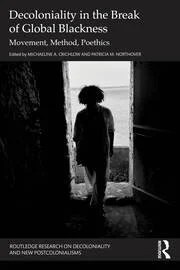
Decoloniality in the Break of Global Blackness: Movement, Method, Poethics
Michaeline Crichlow and Patricia Northover
This book, contextualized by the violence of globalization, investigates the fungible, fugitive, and untenable experiences of Black being and time through a decolonial poethics of global*Blackness. In so doing it introduces innovative readings of coloniality/decoloniality by threading its meaning and movement through the “problem” of Blackness.
It argues that global*Blackness is the complexly entangled other side of decoloniality, as movement, method, and poethics for radical new worlds. The essays explore this through inter/transdisciplinary, creative, and decolonial standpoints, whether from prison abolitionist demands to Afrofuturist imaginaries, or by seeing through Black mirrors. It emphasizes the paradoxical characteristics of global*Blackness—its spectral quality of being in and out of modernity’s self-narrative—to provide a way of dwelling with global Blackness as a force that is neither “properly” constituted by corporeality nor thinkable in ontological terms determined by modern power.
The book will be of interest to academics, researchers, and students in the fields of social sciences, cultural studies, postcolonial studies as well as cultural practitioners, art educators, artists, cultural activists, and those institutions that seek to decolonize imaginaries, thought, practices, and methods. Given its diverse offerings, it will also be of interest to upper-level undergraduates, graduate students, and academics.

Globalization and the Post-Creole Imagination
Michaeline Crichlow and Patricia Northover
Globalization and the Post-Creole Imagination is a major intervention into discussions of Caribbean practices gathered under the rubric of “creolization.” Examining sociocultural, political, and economic transformations in the Caribbean, Michaeline A. Crichlow argues that creolization—culture-creating processes usually associated with plantation societies and with subordinate populations remaking the cultural forms of dominant groups—must be liberated from and expanded beyond plantations, and even beyond the black Atlantic, to include productions of “culture” wherever vulnerable populations live in situations of modern power inequalities, from regimes of colonialism to those of neoliberalism. Crichlow theorizes a concept of creolization that speaks to how individuals from historically marginalized groups refashion self, time, and place in multiple ways, from creating art to traveling in search of homes. Grounding her theory in the material realities of Caribbean peoples in the plantation era and the present, Crichlow contends that creolization and Creole subjectivity are constantly in flux, morphing in response to the changing conditions of modernity and creatively expressing a politics of place.

Race and Rurality in the Global Economy
Michaeline Crichlow and Patricia Northover
Issues of migration, environment, rurality, and the visceral “politics of place” and “space” have occupied center stage in recent electoral political struggles in the United States and Europe, suffused by an antiglobalization discourse that has come to resonate with Euro-American peoples. Race and Rurality in the Global Economy suggests that this present fractious global politics begs for closer attention to be paid to the deep-rooted conditions and outcomes of globalization and development. From multiple viewpoints the contributors to this volume propose ways of understanding the ongoing processes of globalization that configure peoples and places via a politics of rurality in a capitalist world economy, and through an optics of raciality that intersects with class, gender, identity, land, and environment. In tackling the dynamics of space and place, their essays address matters such as the heightened risks and multiple states of insecurity in the global economy; the new logics of expulsion and primitive accumulation dynamics shaping a new “savage sorting”; patterns of resistance and transformation in the face of globalization’s political and environmental changes; the steady decline in the livelihoods of people of color globally and their deepened vulnerabilities; and the complex reconstitution of systemic and lived racialization within these processes. This book is an invitation to ask whether our dystopia in present politics can be disentangled from the deepening sense of “white fragility” in the context of the historical power of globalization’s raced effects.
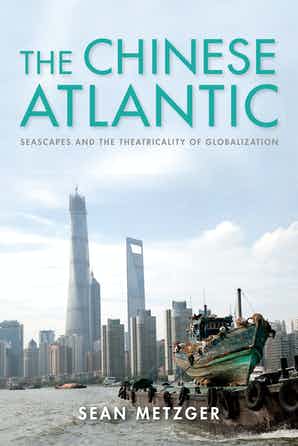
The Chinese Atlantic: Seascapes and the Theatricality of Globalization
Dr. Sean Metzger
In The Chinese Atlantic, Sean Metzger charts processes of global circulation across and beyond the Atlantic, exploring how seascapes generate new understandings of Chinese migration, financial networks and artistic production. Moving across film, painting, performance, and installation art, Metzger traces flows of money, culture, and aesthetics to reveal the ways in which routes of commerce stretching back to the Dutch Golden Age have molded and continue to influence the social reproduction of Chineseness. With a particular focus on the Caribbean, Metzger investigates the expressive culture of Chinese migrants and the communities that received these waves of people. He interrogates central issues in the study of similar case studies from South Africa and England to demonstrate how Chinese Atlantic seascapes frame globalization as we experience it today. Frequently focusing on art that interacts directly with the sites in which it is located, Metzger explores how Chinese migrant laborers and entrepreneurs did the same to shape—both physically and culturally—the new spaces in which they found themselves. In this manner, Metzger encourages us to see how artistic imagination and practice interact with migration to produce a new way of framing the global.
 The Haitians: A Decolonial History
Dr. Jean Casimir
In this sweeping history, leading Haitian intellectual Jean Casimir argues that the story of Haiti should not begin with the usual image of Saint-Domingue as the richest colony of the eighteenth century. Rather, it begins with a reconstruction of how individuals from Africa, in the midst of the golden age of imperialism, created a sovereign society based on political imagination and a radical rejection of the colonial order, persisting even through the U.S. occupation in 1915.
 LatinX
Dr. Claudia Milian
LatinX, according to Claudia Milian, is the most powerful conceptual tool of the Latino/a present, an itinerary whose analytic routes incorporate the Global South and ecological devastation. Milian’s trailblazing study deploys the indeterminate but thunderous “X” as intellectual armor, a speculative springboard, and a question for our times that never stops being asked.
 The Politics of Decolonial Investigations
Dr. Walter Mignolo
In The Politics of Decolonial Investigations Walter D. Mignolo provides a sweeping examination of how coloniality has operated around the world in its myriad forms from the sixteenth century to the twenty-first. Decolonial border thinking allows Mignolo to outline how the combination of the self-fashioned narratives of Western civilization and the hegemony of Eurocentric thought served to eradicate all knowledges in non-European languages and praxes of living and being. Mignolo also traces the geopolitical origins of racialized and gendered classifications, modernity, globalization, and cosmopolitanism, placing them all within the framework of coloniality.
 Essays on Global Blackness & Questions of Freedom